Wolf Oven Repair
Concord: The Self-Clean Cycle Ended and the Wolf Door Will Not Open
The lock is not a jammed bolt. It is a small motor, a switch reporting where that bolt sits, and a control that refuses to release until the two agree — which is why a Wolf door can stay shut for hours after a self-clean cycle has finished.
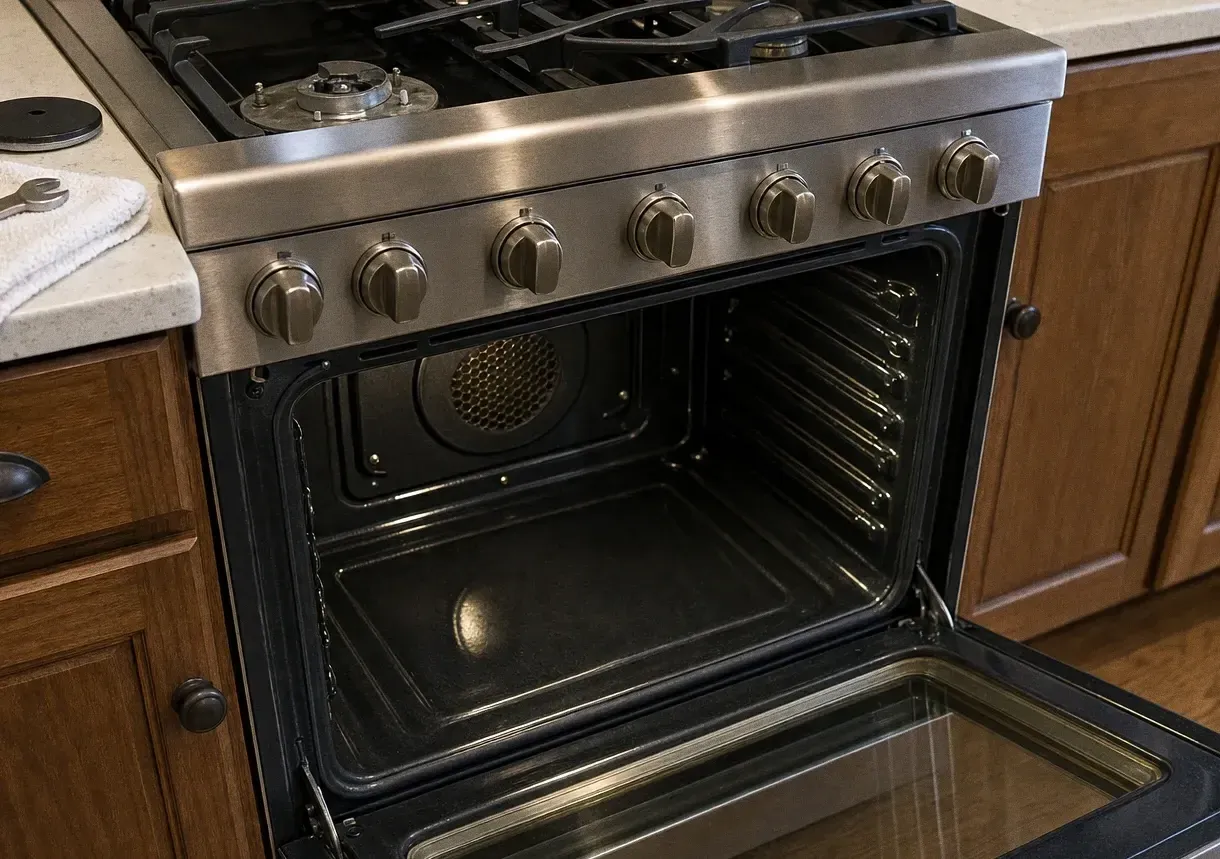
The word “locked” does most of the damage here. It makes people picture a seized bolt, a mechanism that has jammed, something that could be persuaded with enough leverage. That is not what is holding the door.
What is holding it is a conversation. A small motor moves a bolt. A switch watches where that bolt has ended up and reports back. A control refuses to declare the door open until the report agrees with the instruction it gave. Once you can picture those three parts, almost every version of this fault becomes readable, including the very common version where nothing is wrong at all.
First: how long is it supposed to stay locked?
The control is not counting minutes. It is watching the cavity temperature, and it keeps the door secured until that temperature has come down past a threshold it is waiting for. That threshold is reached considerably later than the end of the heating phase, which is why an appliance can appear finished and still be firmly shut.
From the kitchen the whole cool-down is unremarkable. You may see a cleaning or cooling indication on the panel, or nothing more interesting than the clock. A fan will often still be turning over — that is the appliance still working through the cool-down, not a fault.
Use the waiting time to collect information. Is the panel lit and does it respond to touch? Is the fan audible? Has any code appeared? Is the door glass still warm to the back of your hand? Those four answers shape everything that follows, and they are difficult to recover once you have started interrupting the power.
Waiting stops being the answer once the appliance has genuinely settled — cool glass, fan silent, an ordinary display — and the door remains fast. Around Nine Acre Corner, where kitchens tend to be built for cooking in quantity and the cycle usually gets started after a big weekend, that point is often reached overnight and discovered at breakfast.
Locked, or locked and dead? They are different faults
Look at the display before forming any theory. A panel that is lit and behaving normally means the appliance is working and declining to release. A panel that is completely dark means something else entirely: the oven has no power, and the latch is simply parked wherever it stood when the supply disappeared.
For the dark case, check the breaker once. A single deliberate power interruption is a legitimate test — if the display wakes up and the sequence resumes, supply was your answer. What it is not is a repair, and treating it as one leads people into a loop.
When the breaker is fine and the panel stays dark, suspect the thermal fuse. Think of it as a deliberate weak link in the circuit: when it goes, it goes for good, and the only cure is a new one. There is no button to press and nothing to reset. It is placed there so that an inexpensive component surrenders before an expensive one does, and after a cycle that hot it has often done exactly that.
So repeatedly resetting the breaker is not a plan. It cannot restore an opened fuse, it will not make a stalled latch motor move, and if there is a genuine electrical fault behind it you are simply recreating the conditions that caused it.
Motor, switch, and a control that wants agreement
Now the mechanism itself, in behavioural terms. When the cycle starts, the control energises the latch motor, the bolt travels across the door, and the switch changes state to confirm the door is secured. At the end, the reverse: the motor is told to withdraw the bolt, the switch is expected to change state again, and only then does the control consider the door available.
Two failures look identical from the kitchen and are not the same at all. In the first, the bolt never moved — the motor did nothing, or something stopped it, and the door genuinely is secured. In the second, the bolt moved perfectly well but the switch never reported it, so the door is mechanically free while the control carries on treating it as shut. The difference matters, because it decides which part gets replaced.
Heat contributes a third possibility. A cycle that runs the cavity far above normal cooking temperatures can leave the travel path fouled with hardened residue, or leave a component along it slightly distorted, so the bolt moves partway and stops. That version often announces itself: a short buzz or whirr each time the control tries, followed by nothing.
That is the boundary. Everything described here sits inside a high-current appliance that may still hold real heat, behind panels that are not intended to be removed in a domestic kitchen. In the Concord Center houses, where an oven is frequently built into a rear ell against original chimney masonry, there is often no practical access from the side at all. Our Wolf Oven Repair page explains what the visit covers. It opens with the $95 service call; door hinge, glass and seal work runs $210 to $900, and a control board or touch panel between $520 and $1,670.
What a technician can do that you cannot
Three findings end the do-it-yourself stage on the spot. A burning electrical smell off the appliance. A breaker that goes a second time once you have reset it. A door still held fast when everything has been cold and silent for hours. None of those improve with patience.
A visit turns guesswork into measurement. Continuity across the thermal fuse is a two-minute test with the right instrument and impossible without one. Whether the latch motor is being commanded and whether it responds is observable at the connector. And what the control currently believes about door position — the crucial question in the switch-failure case above — can be read directly rather than inferred.
One thing not to do, plainly. No prying, no levering, no shoulder against it. Hand force was never something the mechanism was built to resist, and what usually gives way is the latch assembly and the door together, which converts a straightforward part swap into a considerably larger job. Nothing about a locked door improves under mechanical persuasion.
Wolf Repair Concord works across West Concord, Nine Acre Corner and Conantum — including the Conantum houses where the kitchen is open to the room and there is nowhere to hide a partly dismantled appliance, so we plan the visit accordingly. Have the model number and any code on the display ready, then ring (401) 373-4040 or book through the link on this page.
Still asked on the phone
- What is a thermal fuse and why did it blow?
- It is a one-time safety component wired into the circuit, designed to open permanently if temperature in its area exceeds what the appliance should ever see. It does not reset and cannot be repaired; it is replaced. It usually opens during or just after a self-clean cycle because that is when the appliance is hottest, and a blocked cooling path, a stuck cooling fan or a door seal that is no longer sealing will push conditions past its limit.
- The oven opened but now will not heat — are the two related?
- Very often, yes. Both symptoms can share one cause: an opened thermal fuse cuts a circuit the heating side depends on while leaving other functions apparently normal. The alternative is that a component already near the end of its service life failed during the cycle, since self-clean stresses everything far harder than baking does. Either way, tell whoever attends that the two events happened together — the sequence narrows the diagnosis considerably.
- The display shows a code — does that tell me which part failed?
- No. A code records what the control observed, such as a reading outside its expected range or a confirmation that never arrived, and several different physical faults can produce the same code. It is a starting point rather than an answer. Photograph the panel before you interrupt the power, because a code that returns immediately after a restart carries far more diagnostic weight than one that clears and stays cleared.